Labour Book App — The Running Wage Ledger for Contractors
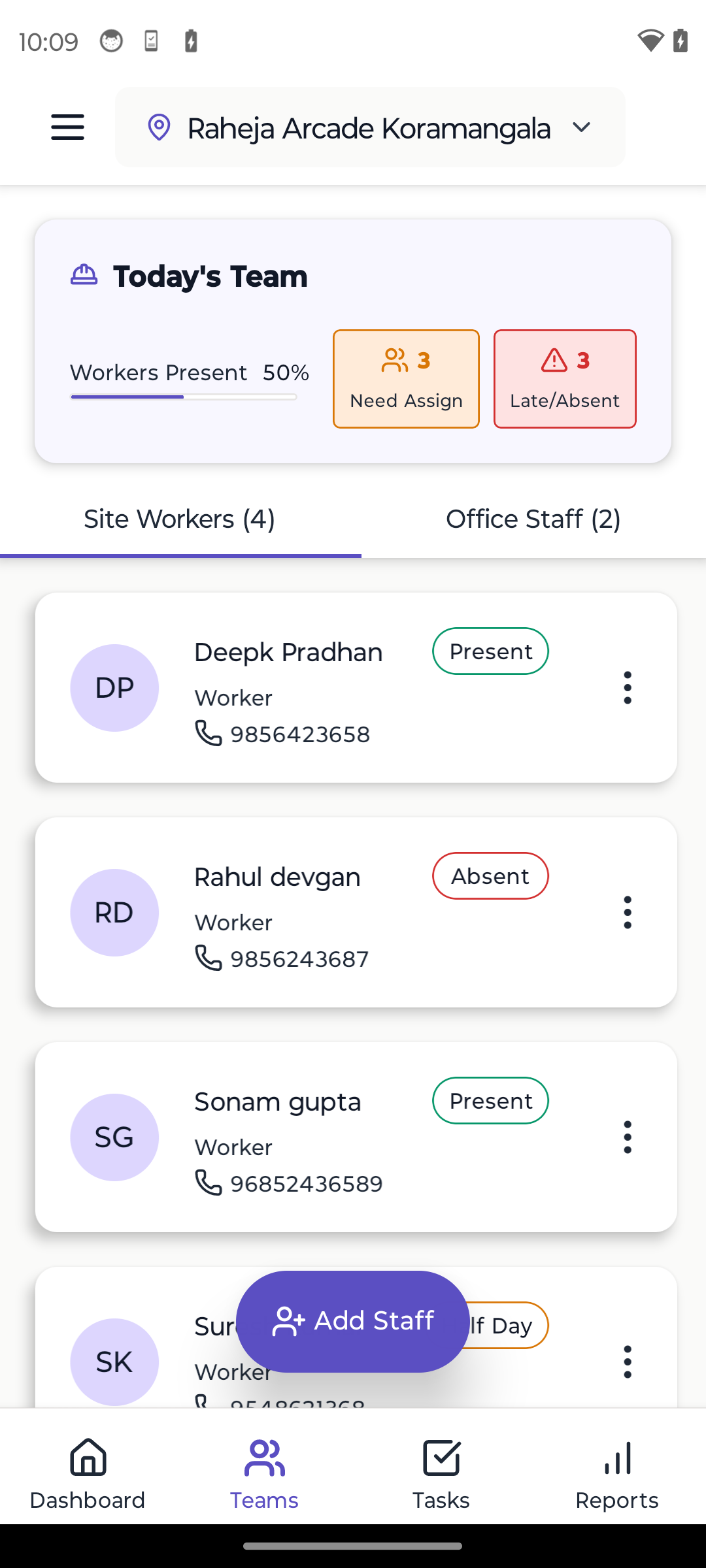
A labour book is not the daily attendance register — it is the running wage ledger. It tells you what you owe each worker at the end of the week or the month, once you net out the advances you have already paid out. The Yojo labour book app keeps this running ledger on a phone, per worker, per site, with every advance and deduction time-stamped. Settlement day stops being a Saturday-night spreadsheet exercise.
By the Yojo Product Team ·
Why Yojo Labour Attendance App?
Built for Indian construction sites
One-Tap Attendance
Mark attendance in one tap. No paper, no Excel.
100% Offline
Works without internet. Sync when connected.
Prevent Fake Attendance
Photo and geo-fence proof. No ghost workers.
How is the labour book different from a hajri register?
A hajri register answers "did Ramesh come today?". A labour book answers "after thirteen days of work, two half-days, three advances, and one cash adjustment, how much is owed to Ramesh this Saturday?". The labour book is the document a contractor pulls out at settlement time — when wages are paid weekly, fortnightly, or monthly. It is also the document a worker will dispute in front of the mukadam if the numbers do not match what they remember.
How the running balance works per worker
How the running balance works per worker
Open the labour book in Yojo and pick a worker. You see a single running balance: total earned so far this cycle minus total advances given. Every entry is dated and source-tagged — "advance Tuesday Rs 500", "half-day Wednesday minus Rs 250", "overtime Friday plus Rs 300". On settlement day, the running balance is the closing payout. No second-pass calculation. No Saturday-night reconciliation. The labour book just is the answer.
Per-skill wage rates that apply automatically
Set the rate once per skill (mason ₹800, helper ₹500, rajmistri ₹950) and Yojo applies it automatically based on each worker's tag. Change the rate mid-cycle and only future days use the new rate; historical entries stay locked to what they were marked at.
Logging an advance against the running balance
When a worker asks for a mid-week advance, tap "advance" on their profile and enter the amount. The labour book balance nets it immediately. The pagar khata receives the same entry. No separate notebook, no Saturday reconciliation surprise.
Closing the running balance on settlement day
On settlement day, open the labour book — the closing balance per worker is the payout. Print or export the PDF, mark the cycle closed, and Yojo opens a fresh balance for the next cycle. Settlement takes minutes, not hours.
Multi-site labour books and per-project settlements
Contractors running three projects do not want one labour book — they want three labour books that close independently on different weeks. Yojo keeps a per-site labour book, so Site A can settle on Saturday while Site B settles on the 30th and Site C runs fortnightly. Each labour book exports to PDF or Excel — the same format your principal contractor expects.
How does a digital labour book hold up in a wage dispute?
If a worker claims they were underpaid, the paper labour book is hard to defend — entries can look retro-edited or unclear. Yojo timestamps every entry, every advance, and every adjustment. The labour book PDF you hand the worker (or the labour inspector) shows when each number was entered and by which supervisor. Disputes resolve faster because the running ledger has a full audit trail.
How a Bangalore contractor cut Saturday-night settlement to 30 minutes
Ravi K. runs a 50-worker civil contracting business in Bangalore. Before Yojo, Saturday wage settlement took roughly 4 hours of paper-ledger reconciliation: six weekly attendance pages, per-skill day rates, half-day fractions, advance deductions, all double-checked by his accountant. Errors caused worker disputes most weeks. After switching to a digital labour book, Saturday settlement runs in about 30 minutes — open the labour book, review the running balance per worker, print and pay. The 3.5 hours saved each week (~180 hours/year) is the difference between his accountant focusing on growth and reconciling rows. This is a generic pattern Yojo sees across small contractors; specific results vary by crew size and rate complexity.
Compliance context: BOCW Act 1996 and the wage register
The Building and Other Construction Workers (BOCW) Act 1996 requires contractors employing 10+ workers on a project to maintain a dated wage register. A digital labour book that exports to PDF (as Yojo does, with timestamped entries) is increasingly accepted by state labour inspectors in lieu of the legacy hand-written paper register. Always check the specific notification for your state — for example, the Karnataka Department of Labour publishes annual minimum wage updates at labour.karnataka.gov.in, and the central Ministry of Labour & Employment lists notifications at labour.gov.in. The labour book Yojo generates surfaces the entries an inspector typically asks for: dated daily attendance, per-worker wage rates, overtime hours, advances given, and the closing balance.
How hajri, muster roll, labour book, and pagar khata relate
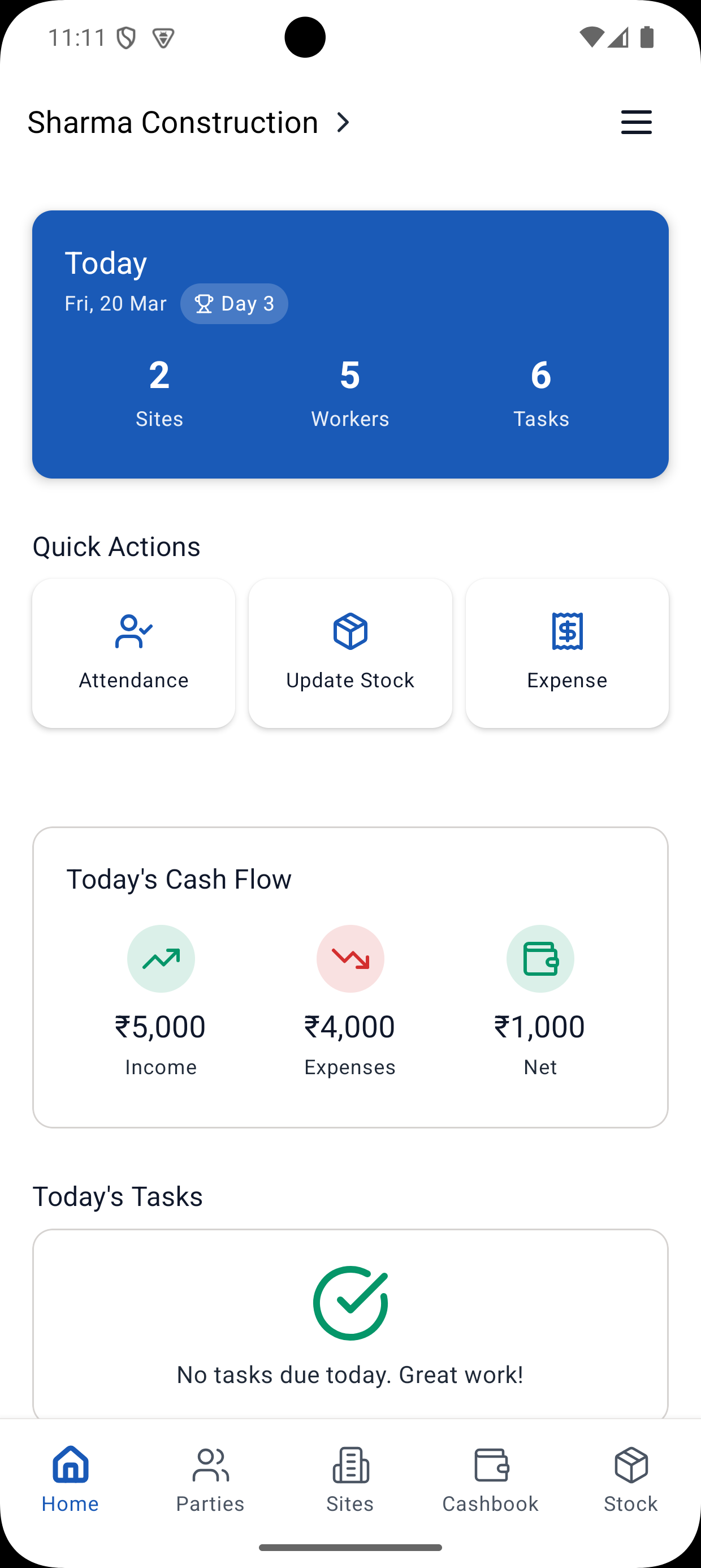
These four terms describe four different artefacts. Hajri is the daily attendance mark. Muster roll is the daily attendance document for compliance and client reporting. Labour book is the running wage ledger — what is owed, accumulating across the week or month. Pagar khata is the cash and advance ledger. Yojo records all four off the same underlying data, so marking hajri once produces the muster roll, updates the labour book balance, and posts to the pagar khata.
For the full glossary covering contractor-hierarchy roles (thekedar, mukadam, mate, mistri, rajmistri, beldar, helper) and regional variants in Marathi, Tamil, Telugu, Bengali, and Gujarati, see the [labour terminology page](/en/labour-terminology/).
Free to start — built for Indian contractor settlement cycles
Download Yojo, set up a worker list with skill-level wage rates, and your first labour book is ready before the first Saturday closes. Free plan available — no card needed. Built in India for weekly, fortnightly, and monthly contractor settlement cycles.
How Yojo Works
- 1
Download the App
Get Yojo free from Google Play Store. No signup needed to start.
- 2
Add Your Sites & Team
Add your construction sites, workers and subcontractors in minutes.
- 3
Start Managing
Track attendance, wages, expenses and materials. Works 100% offline.
What contractors say
Trusted by Contractors Across India
See what our users have to say about managing their construction business with Yojo.
"Earlier I used to sit with registers till 8. Now I close by 6 and still send the DPR to the client."
"Fifty workers, one phone. I used to worry about wrong counts—now I just tap and it’s done."
Names changed to protect privacy. Based on real user experiences.
FAQ
Last updated: 19 May 2026
From Site to Salary, Track Everything
Download Yojo
Free on Android

Digital labour book vs paper labour book
Both record attendance and wages; the real difference shows up on settlement day.
| Aspect | Digital labour book (Yojo) | Paper labour book |
|---|---|---|
| Time to close Saturday settlement | ~30 minutes (live running balance) | 2-4 hours of manual arithmetic |
| Audit trail in a wage dispute | Every entry timestamped + supervisor name | Hand-written; date confusion common |
| Advance tracking | Every advance auto-netted against running balance | Often a separate notebook; sync errors |
| Multi-site close (different settlement cycles) | Per-site labour book; closes independently | All in one book or scattered papers |
| Worker-side proof copy | PDF / WhatsApp summary | Verbal confirmation only |
- Digital labour book (Yojo)
- ~30 minutes (live running balance)
- Paper labour book
- 2-4 hours of manual arithmetic
- Digital labour book (Yojo)
- Every entry timestamped + supervisor name
- Paper labour book
- Hand-written; date confusion common
- Digital labour book (Yojo)
- Every advance auto-netted against running balance
- Paper labour book
- Often a separate notebook; sync errors
- Digital labour book (Yojo)
- Per-site labour book; closes independently
- Paper labour book
- All in one book or scattered papers
- Digital labour book (Yojo)
- PDF / WhatsApp summary
- Paper labour book
- Verbal confirmation only
Authoritative resources
Wage, BOCW, and EPF compliance statements on this page are based on primary government sources. Direct links below:
- Ministry of Labour & Employment, Government of India
Central labour notifications, the BOCW Act, EPF, ESI, and Contract Labour Act texts.
- BOCW Central Portal
Building and Other Construction Workers Welfare Board — registration, cess, and benefits.
- Employees Provident Fund Organisation (EPFO)
PF contribution rules, threshold compliance, and member registration.
- ILO India — Labour Standards
International Labour Organization country profile and standards for India.
