Attendance App for Contractors — Built Around the Mukadam Workflow
An attendance app for contractors is a different category from an office HR app. The contractor's reality is a mukadam-to-thekedar chain of command, cash advances given mid-week against not-yet-earned wages, daily-rate workers whose pay changes if they leave at lunch, PF that only applies when the worker count crosses a threshold, and a subcontractor reporting up to a principal contractor who wants the data in his own format. Yojo is built around this reality — not retrofitted from an office attendance product.
By the Yojo Product Team ·
Why Yojo Labour Attendance App?
Built for Indian construction sites
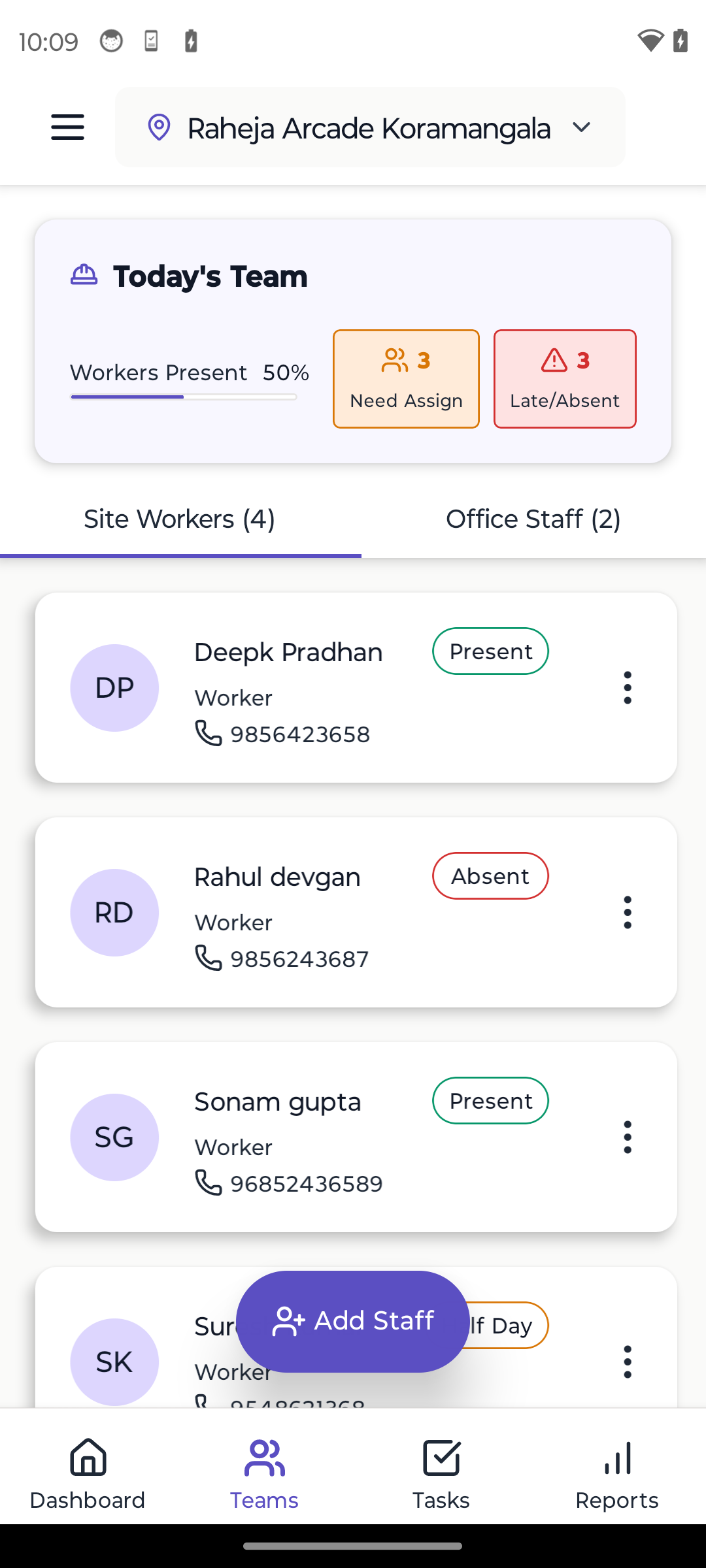
One-Tap Attendance
Mark attendance in one tap. No paper, no Excel.
100% Offline
Works without internet. Sync when connected.
Prevent Fake Attendance
Photo and geo-fence proof. No ghost workers.
How does the mukadam-to-thekedar chain of command actually work on site?
How does the mukadam-to-thekedar chain of command actually work on site?
The mukadam is the leader of a 5-to-20 person crew. He marks his crew's attendance, knows who is good for an advance, decides who works late. The thekedar (contractor) runs three to five mukadams across one or more sites. The data flow up the chain — mukadams mark, thekedar sees totals across all crews, the principal contractor sees the consolidated muster from the thekedar. Yojo encodes this hierarchy as roles, so a mukadam sees only his crew, a thekedar sees all his mukadams' crews, and the principal contractor (when given access) sees only the consolidated daily totals from this thekedar.
The mukadam's view: just their crew
Open Yojo as a mukadam and you see exactly your 8-20 workers — no one else's. Mark hajri, give an advance, add a note. You can't accidentally edit another mukadam's crew, and the thekedar can see what you did and when.
The thekedar's view: all mukadams across all sites
As thekedar, you see every mukadam's crew across every site you run. Roll-ups by site, by skill, by mukadam. You can override an entry (with a logged audit reason) if a dispute needs resolution.
The principal contractor's view: consolidated totals only
If you sub-contract to L&T or Tata Projects, you can grant them read-only access to the consolidated daily total — worker count by skill, no per-worker detail. Enough for the muster roll they need; private enough that your wage rates and advance ledger stay yours.
Cash advance running ledger — the contractor's real headache
A worker asks for Rs 1,500 advance on Tuesday because of a family emergency. Wednesday earnings are not yet calculated. The mukadam writes it in a notebook. By Saturday settlement, three workers have taken advances, the mukadam's notebook is somewhere, and the thekedar is doing mental arithmetic. Yojo keeps the advance ledger per worker, ties each advance back to the worker's [labour book](/en/labour-book/) balance, and shows the running net at any point in the cycle. Saturday settlement is the running net — not a rediscovery exercise. (For the marking side of the same workflow, see the [hajri book app](/en/hajri-book/).)
Subcontractor reporting up to principal contractor — the data format that matters
A subcontractor working under L&T, Tata Projects, or a state PSU does not just need attendance for himself — he needs it in the format the principal's contracts department expects. Worker IDs, photo IDs, BOCW registration numbers if applicable, daily attendance with skill codes, and a weekly muster certified by the principal's site engineer. Yojo generates the same data in the principal's expected format — PDF for some, Excel template upload for others, API submission for the larger principals.
How an Indore civil contractor collapsed three notebooks into one
Manoj S. runs a civil contracting business in Indore with 35 workers across two simultaneous projects. Before Yojo, he kept three parallel notebooks: a hajri register for attendance, a pagar khata for cash advances given mid-week, and a wage register for the monthly settlement. Two of the three notebooks routinely fell out of sync — an advance written in the pagar khata but not deducted in the wage register caused two-thousand-rupee disputes most months. After moving to an attendance app built around the contractor workflow, the three notebooks collapsed into one digital record: marking hajri updates the wage running balance, and recording an advance immediately nets against that balance. The cross-notebook sync problem disappeared. Generic pattern; complexity scales with the contractor's advance frequency and crew size.
Compliance context: EPF threshold, BOCW cess, and the contractor trap
The Employees' Provident Funds Act 1952 makes EPF contributions mandatory when an employer (including a contractor) employs 20 or more eligible workers. A contractor who crosses this threshold mid-year by starting a new project can face retroactive contribution liability — penalty interest accrues from the date the threshold was crossed, not the date the contractor noticed. The BOCW Welfare Cess Act 1996 levies a 1% cess on construction projects above ₹10 lakh in cost, payable to the state welfare board. An attendance app for contractors that tracks worker counts across all sites and flags the EPF threshold approach (as Yojo does) prevents the trap. Always verify with a chartered accountant before formally enrolling under EPF; rules and thresholds are subject to amendment. Central EPF guidance: epfindia.gov.in.
Start free — built for Indian contractor settlement realities
Download Yojo, set up your mukadams and worker list, and the first daily attendance, advance, and settlement flow runs today. Free plan available. Built for the contractor whose actual daily reality is mukadams, advances, daily wages, and a principal contractor on WhatsApp asking for today's number.
How Yojo Works
- 1
Download the App
Get Yojo free from Google Play Store. No signup needed to start.
- 2
Add Your Sites & Team
Add your construction sites, workers and subcontractors in minutes.
- 3
Start Managing
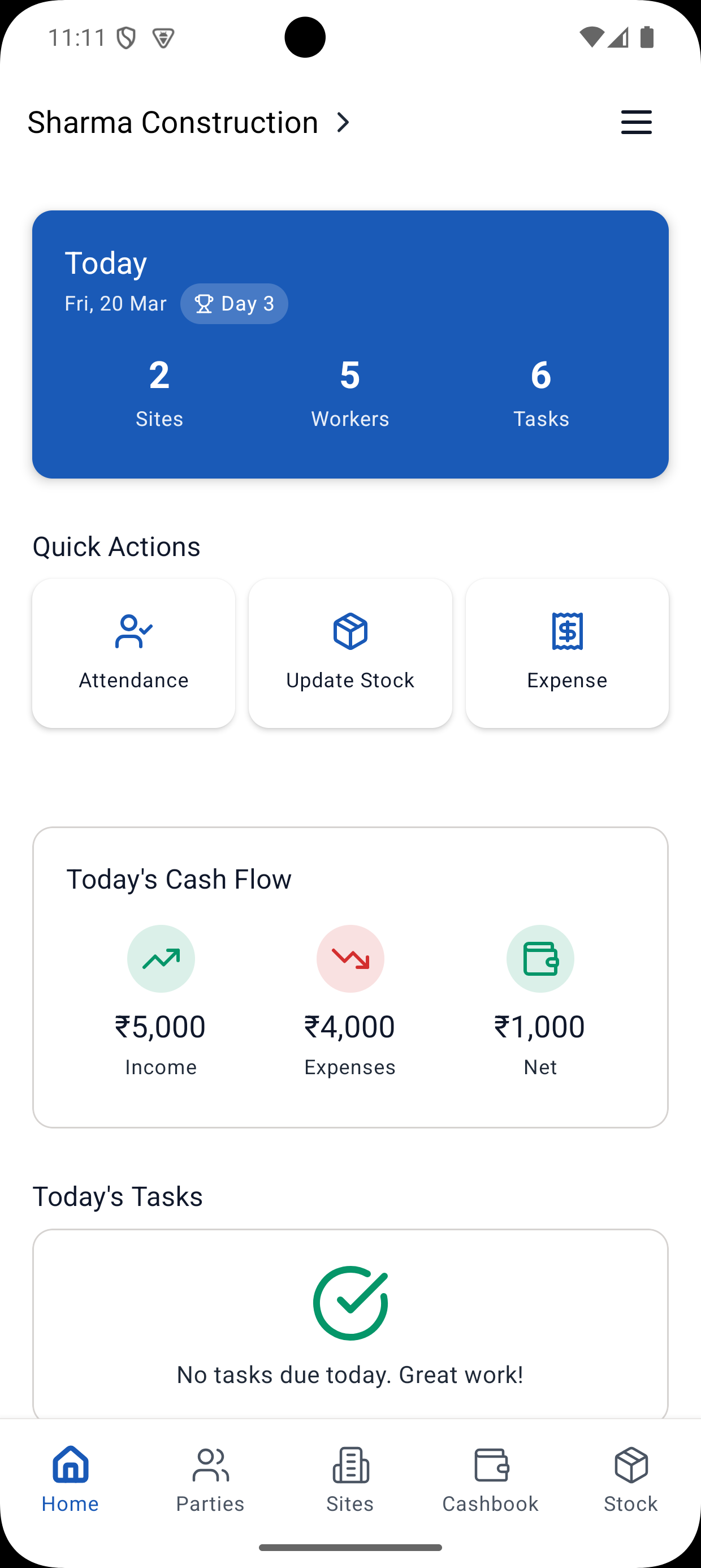
Track attendance, wages, expenses and materials. Works 100% offline.
What contractors say
Trusted by Contractors Across India
See what our users have to say about managing their construction business with Yojo.
"Earlier I used to sit with registers till 8. Now I close by 6 and still send the DPR to the client."
"Fifty workers, one phone. I used to worry about wrong counts—now I just tap and it’s done."
Names changed to protect privacy. Based on real user experiences.
FAQ
Last updated: 19 May 2026
From Site to Salary, Track Everything
Download Yojo
Free on Android

Office HR app vs contractor attendance app
Why a generic office HR app doesn't fit the construction site reality.
| Aspect | Office HR app | Yojo (contractor-first) |
|---|---|---|
| Daily-wage worker support (per-day rate) | Assumes monthly salary | Per-day rate per skill |
| Mukadam-to-thekedar hierarchy | No | Yes |
| Offline marking (no-signal sites) | No | Yes |
| Cash advance running ledger | No | Yes |
| EPF threshold (20+ workers) flagging | Partial | Yes |
- Office HR app
- Assumes monthly salary
- Yojo (contractor-first)
- Per-day rate per skill
- Office HR app
- No
- Yojo (contractor-first)
- Yes
- Office HR app
- No
- Yojo (contractor-first)
- Yes
- Office HR app
- No
- Yojo (contractor-first)
- Yes
- Office HR app
- Partial
- Yojo (contractor-first)
- Yes
Authoritative resources
Wage, BOCW, and EPF compliance statements on this page are based on primary government sources. Direct links below:
- Ministry of Labour & Employment, Government of India
Central labour notifications, the BOCW Act, EPF, ESI, and Contract Labour Act texts.
- BOCW Central Portal
Building and Other Construction Workers Welfare Board — registration, cess, and benefits.
- Employees Provident Fund Organisation (EPFO)
PF contribution rules, threshold compliance, and member registration.
- ILO India — Labour Standards
International Labour Organization country profile and standards for India.
